Meme coin trading on a $10 budget: what five sub-0.05 SOL trades actually prove
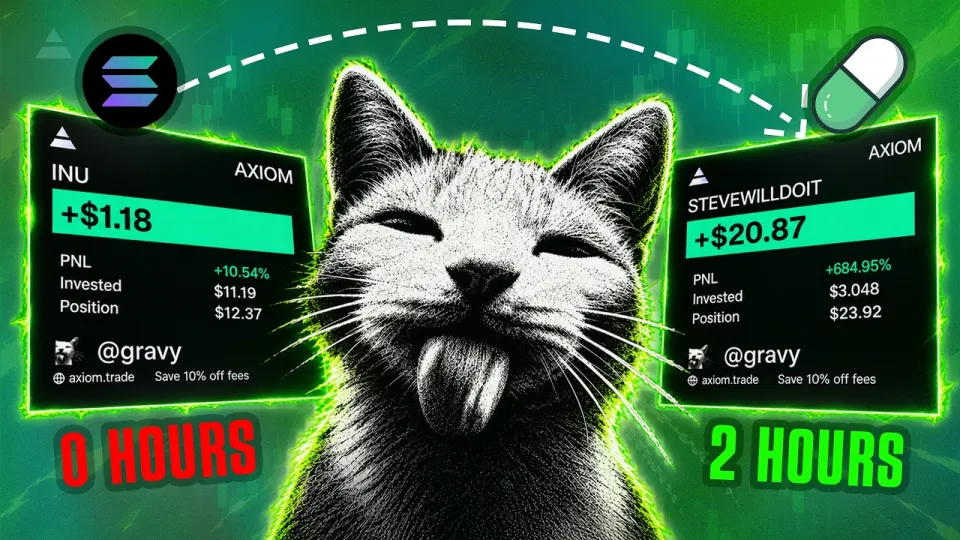
Video: I Tried Trading Memecoins with Just $10
Need articles like this for your video? They help promote it on YouTube and Google — order them in the Telegram bot @sat_sit_bot. Articles with your video embedded are written and posted by the bot itself — on popular topical sites (no ads). Try it free: 50 articles on us.
· based on the channel gravy
Meme coin trading with a $10 bankroll is possible, but only if position size, fees and exit discipline are treated as one problem rather than three. The gravy channel tested it directly in the video I Tried Trading Memecoins with Just $10: five real trades on Solana, none of the buys above 0.05 SOL, each one documented by entry reason and exit. Trading happens through Axiom, the Solana trading terminal used in the video, where the referral link gives cashback and a fee discount.
The experiment matters because the standard objection — that fees and taxes eat a small portfolio alive — is only half true. On Solana there is no transaction tax on a swap; the costs are priority fees, LP fees, slippage and the spread on thin pools. At 0.05 SOL per buy those costs are proportionally brutal, which is exactly what makes the exercise a useful stress test.
What the five trades actually were
Each of the five positions used a different thesis, and the mix shows how varied meme coin setups are even inside one week. The tickers were STEVEWILLDOIT, NPC, MET (Meteora), PUMPY the Trader and UNTXD — a spread across pure meme, ecosystem token and meta-driven plays.
- STEVEWILLDOIT — a narrative-first buy built on a meme spreading through crypto Twitter rather than on any product.
- NPC — a coin riding a widely recognised internet archetype, where the appeal is instant recognition rather than novelty.
- MET (Meteora) — an ecosystem-linked token, closer to a liquidity-infrastructure play than a pure joke coin.
- PUMPY the Trader — a character-driven meme with a trading persona at its centre.
- UNTXD — a late-cycle entry that the creator himself flagged as the one he fumbled.
The honest framing matters: one of five was a clear miss, and the video does not pretend otherwise. That ratio — one acknowledged mistake out of five attempts — is a realistic baseline for anyone learning meme coin trading with a small balance.
Why the X Money coin meta ran
The X Money coin cycle is a case study in how memecoins attach themselves to a live news narrative instead of inventing one. The video traces the move back to the e/acc (effective accelerationism) current and the Cream angle, which gave traders a ready-made story to price.
That pattern repeats constantly. A meta forms when three things line up: a recognisable name or figure, a community that already speaks the language, and a catalyst that puts the name in front of people who do not normally follow crypto. When those three overlap, a token can run on attention alone for hours. When any one is missing, the same ticker stalls.
For a $10 portfolio the practical lesson is that narrative research is the cheapest edge available. You cannot outspend anyone at 0.05 SOL per buy, but you can out-read them. The catch, raised repeatedly by viewers, is the volume of work: scanning tweets, remembering who actually moves a community, and distinguishing a genuine catalyst from a retweet loop.
How to size and execute a sub-0.05 SOL buy
Position sizing is the single decision that determines whether a small meme coin account survives long enough to learn anything. At 0.05 SOL per entry, a $10 bankroll supports a handful of attempts, not a strategy built on averaging down.
A workable sequence for a small account:
- Cap every buy at a fixed fraction of the bankroll — the video's 0.05 SOL ceiling is a reasonable model.
- Check the pool's liquidity before entry; slippage on a thin pair can quietly cost more than the position's upside.
- Set the exit before the buy. A 20–40% stop is common, but so is taking profit into the first spike rather than waiting for a second leg.
- Accept that fees are fixed in absolute terms but huge in relative terms — a swap costing a few cents is trivial on $1,000 and punishing on $10.
- Log every trade with the reason for entry, so the next decision is based on data rather than memory.
The most common failure described by viewers is not picking bad coins — it is selling after a 20–40% drawdown and then watching the same token run higher. That is a sizing and exit-planning problem, not a research problem.
Common questions from small-balance traders
Small-portfolio traders keep running into the same three walls, and each has a practical answer. The first is consistency: how does anyone reliably find coins with good narratives? The second is timing: why does a dip keep dipping after entry? The third is cost: do fees make small trades pointless?
On consistency, the answer is process over inspiration. Build a short watchlist of accounts and communities that have historically front-run metas, and review it on a schedule instead of reacting to whatever is trending. On timing, the fix is usually earlier entry with a smaller size, not a bigger size later. On fees, the arithmetic is simple — if a round trip costs a meaningful percentage of the position, the trade needs a larger expected move to be worth taking, which means fewer, better trades.
A separate and frequently raised point concerns tooling and privacy: browser extensions and VPNs used while trading deserve scrutiny, since a free VPN can monetise browsing data. Treat wallet hygiene and network hygiene as part of the same risk stack as position sizing.
What $10 realistically teaches about meme coins
A $10 account is a simulator with real money attached, and that is its value. The lessons transfer at any size: narrative selection beats indicator stacking, exit discipline beats conviction, and fixed costs punish overtrading more than they punish any single bad pick.
What it does not do is produce income. Five trades at 0.05 SOL cannot generate a meaningful return even with a strong hit rate, and the creator's own closing question — whether to live-trade a doxxed wallet starting from 0.1 SOL or 1 SOL — signals that the next step up in size is where the real test begins. Viewers asked for exactly that follow-up, plus a total PnL figure, which the video leaves out.
Useful links
- Axiom trading terminal with the creator's referral (cashback and reduced fees): https://axiom.trade/@gravy
- The Trenches Discord: https://discord.gg/W7TqkExcSd
- Free Axiom imports and trade signals (NFA): https://discord.gg/9W5j3XUgYB
- Creator's X account: https://x.com/gravyski
- Leverage trading with a 20% futures fee reduction: https://www.bitbase.com/landing-page/trading-earning-Gra?ref=8CYOGY
Bottom line
The gravy channel's $10 experiment is a clean demonstration that meme coin trading is not gated by account size — it is gated by research quality and exit discipline. Five sub-0.05 SOL trades on Solana, one of them a clear fumble, is a more honest sample than most profit screenshots. Anyone repeating the test should start with the same constraints: fixed size, pre-planned exits, logged reasons. If you want to run it yourself, open an Axiom account through the referral link to get the cashback and fee discount, and keep the first deposits small enough that a bad week costs you lessons rather than capital.
Key takeaways
- Five real trades, none larger than 0.05 SOL per buy, executed on Solana through Axiom.
- Tickers covered: STEVEWILLDOIT, NPC, MET (Meteora), PUMPY the Trader and UNTXD.
- The X Money coin meta is tied to the e/acc and Cream narrative cycle rather than to a single token.
- On Solana, priority fees and slippage — not a percentage tax — are the real cost of small-size meme coin trades.
- The creator of the gravy channel asked viewers whether to live-trade a doxxed wallet starting from 0.1 SOL or 1 SOL.
Source: I Tried Trading Memecoins with Just $10 · Markdown version
Questions & answers
Can you really trade meme coins with only $10?
Yes, technically — the constraint is fees and slippage, not the platform. On Solana a swap has no percentage tax, but priority fees, LP fees and thin-pool slippage consume a large share of a 0.05 SOL position. Treat $10 as tuition for learning process, not as a route to meaningful profit.
How do you find meme coins with strong narratives without drowning in Twitter?
Build a short, fixed watchlist of accounts and communities that have historically spotted metas early, and review it on a schedule instead of scrolling reactively. A narrative needs a recognisable name, a community that already speaks the language, and a catalyst that reaches outsiders — if one of the three is missing, the token usually stalls.
Why do I keep selling at a 20–40% loss right before the coin runs higher?
That pattern usually comes from entering late with too much size, which makes the drawdown psychologically unbearable. Enter earlier with a smaller position, define the invalidation level before buying, and size so that a full stop-out costs a fixed, acceptable slice of the bankroll.
Is a small balance actually worth trading, or should I wait until I have more capital?
A small balance is the cheapest way to build habits that scale — position sizing, exit planning, trade logging. What it cannot do is generate income, because fixed costs dominate at 0.05 SOL per trade. Use it to prove a process, then increase size only after the process holds.